
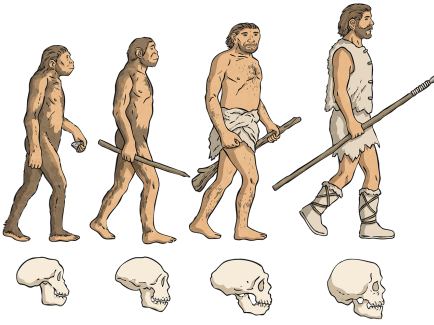
Why is the Statement “Humans Evolved from Chimpanzees” Incorrect?
A very common misconception about evolution is that “humans evolved from chimpanzees” or similar statements suggesting a direct lineage. I’ve even heard someone claim, “We evolved from trees,” which is just entirely incorrect. In this post, I want to dive into the concept of evolution, how it works, and why these statements are misconceptions.
What is Evolution, and How Does It Work?
First and foremost, evolution occurs in populations over long periods of time, not in individuals. The “evolution” of individuals would be more comparable to metamorphosis, which is a completely different process. The most basic definition of evolution is the change in heritable traits within a population over many generations. It’s important to define what we mean by heritable traits and population:
- Heritable traits: characteristics that can be passed from parent to offspring.
- Population: a group of organisms of the same species living in the same area at the same time.
The main mechanisms or drivers of evolution are:
- Genetic drift: changes in allele frequencies due to random chance over generations.
- Mutations: changes in the DNA sequence.
- Natural selection: the process where organisms better suited to their environment are more likely to survive and reproduce.
- Gene flow: the movement of genes between different populations of a species.
Each of these factors can influence a population’s gene pool and, consequently, drive evolution. Of these mechanisms, you have likely heard of natural selection. Natural selection essentially explains how and why species adapt to their environments. It can be easily understood by knowing its three required conditions: variation, inheritance, and differential reproduction and survival. Essentially, a trait needs to be heritable, vary among individuals, and provide some advantage that allows those individuals to survive and reproduce more than others. 11
How Did We Get to Humans?
Starting from the first signs of life on Earth, microbes that lived around 3.7 billion years ago were prokaryotic, very similar to modern-day bacteria or archaea. We know this because of evidence found in rocks from that period. The transition from these single-celled microbes to modern-day humans involved a long and complex evolutionary process. The image below simplifies that relationship a little bit.

It shows the branching from two domains, Bacteria and Archaea, to the kingdoms Plantae, Protista, Fungi, and Animalia. We’ll focus on the kingdom Animalia since humans, or Homo sapiens, belong there.
So yes, humans are very distantly related to all life on Earth, but that does not mean that we evolved directly from any of them. To understand this, you need to understand phylogenetics, the study of evolutionary relationships among biological entities. Looking at a phylogenetic tree showing the relationship between, for example, humans and plants would be extremely complex. Focusing on a specific family, like Hominins (the group that includes humans), makes it easier to understand.
The Journey of Hominin Evolution

Here is a simplified phylogenetic tree that shows humans’ relationship to chimpanzees and other closely related species. As you can see, humans share a common ancestor with chimpanzees that lived around 6-8 million years ago. A common ancestor is a species from which both humans and chimpanzees diverged. This ancestor had traits that evolved differently in each lineage, resulting in distinct species. Meaning that both humans and chimps evolved from this common ancestor, but neither evolved directly from the other.
In the tree below, you can see that relationship and diversification. It also highlights when significant adaptations appeared, such as bipedalism, tool use, large brains, and fire use.
- Bipedalism: the ability to walk on two legs, or stand upright

Some of the key species in the human lineage that appear in the Homo group include:
- Homo habilis: lived 2.4-1.4 million years ago; one of the earliest members of the genus Homo. It still retained some ape-like features, such as long arms and prognathic face.
- Homo erectus: lived 1.89 million-110,000 years ago; the oldest known early human, and had modern-human-like proportions with longer legs and shorter arms.
- Homo neanderthalensis: lived 400,000-40,000 years ago; our closest extinct relative. They were shorter and stockier than modern humans but had a similar brain size. There is also evidence that modern humans and Neanderthals co-existed for some time and even interbred.
Traits that Define Modern Humans
Modern humans, Homo sapiens, are distinguished by certain traits that set us apart from our closest relatives including:
- a lighter skeletal build
- very large brains relative to body size
- a reorganized skull with a vertical forehead
- distinct facial features, such as a much less prominent brow ridge and smaller teeth
Conclusion
So, why is the statement “Humans evolved from chimpanzees” incorrect? The answer lies in the fact that we share a common ancestor with chimpanzees that lived millions of years ago. Our genus, Homo, continued to evolve (and continues evolving because everything is constantly evolving) into the modern-day Homo sapiens we know today. A similar explanation applies to our relationship with other life forms, like trees, though you would have to go back much further in time to find the most recent common ancestor we share with them.
I encourage you to explore more about human evolution if you’re interested, and feel free to leave a comment if you have any questions. Thank you so much for reading! If you’d like to stay updated on new posts, don’t forget to subscribe!
References
- Smithsonian Institution. “Homo sapiens.” Human Origins Program, n.d., https://humanorigins.si.edu/evidence/human-fossils/species/homo-sapiens.
- Gibbons, Ann. “An Essential Timeline for Understanding the Evolution of Homo sapiens.” Smithsonian Magazine, 13 May 2021, https://www.smithsonianmag.com/science-nature/essential-timeline-understanding-evolution-homo-sapiens-180976807/.
- Australian Museum. “Homo sapiens (Modern Humans).” Australian Museum, n.d., https://australian.museum/learn/science/human-evolution/homo-sapiens-modern-humans/.
- “Human Evolution.” Encyclopaedia Britannica, n.d., https://www.britannica.com/science/human-evolution.
- Natural History Museum. “The Origin of Our Species.” Natural History Museum, n.d., https://www.nhm.ac.uk/discover/the-origin-of-our-species.html.
- University of California Museum of Paleontology. “Common Ancestor.” Understanding Evolution, n.d., https://evolution.berkeley.edu/glossary/common-ancestor/.
- University of Utah Health. “Common Ancestors.” Learn Genetics, n.d., https://learn.genetics.utah.edu/content/evolution/common/.
- Smithsonian Institution. “Homo habilis.” Human Origins Program, n.d., https://humanorigins.si.edu/evidence/human-fossils/species/homo-habilis.
- Smithsonian Institution. “Homo erectus.” Human Origins Program, n.d., https://humanorigins.si.edu/evidence/human-fossils/species/homo-erectus.
- Smithsonian Institution. “Homo neanderthalensis.” Human Origins Program, n.d., https://humanorigins.si.edu/evidence/human-fossils/species/homo-neanderthalensis.
- Ayala, F. J. (2019). Evolution. In Encyclopædia Britannica. https://www.britannica.com/science/evolution-scientific-theory
 Emily's Biology Blog
Leave a comment