
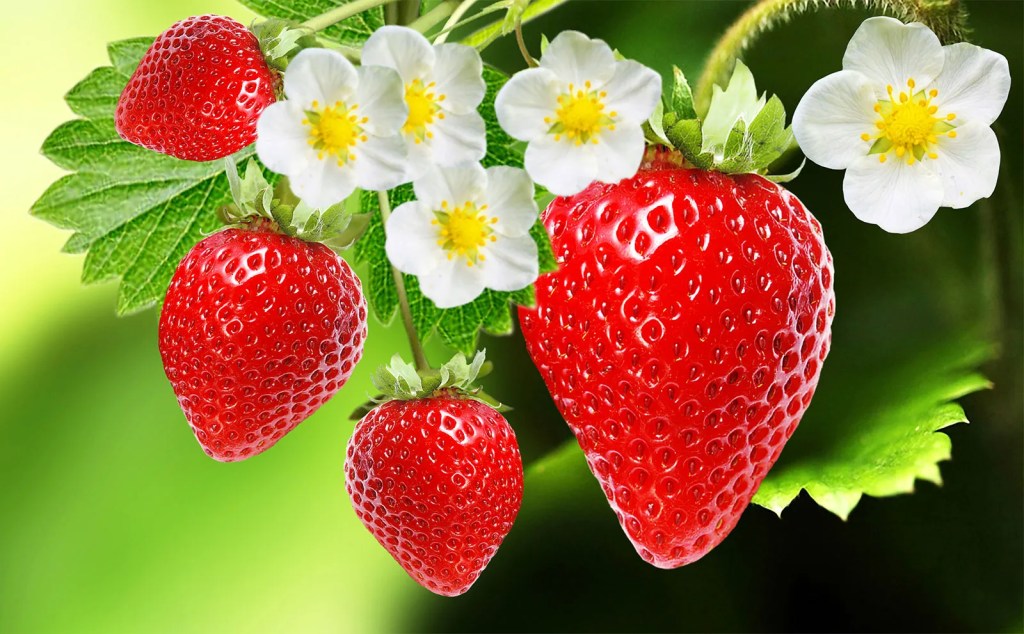
It is a common belief that plants are much simpler than humans or other animals, but when you take the time to study them, you realize how complex they truly are. There are so many different parts of their anatomy and kinds of leaf arrangements that we could go into in great detail, but I want to focus specifically on flowers and fruits. Before learning about this, I didn’t fully understand what fruits and seeds truly were, or that some foods we consider to be berries are not actually berries. There is also a lot more terminology and many more parts to these structures than I will go into here, so this is a very condensed and simplified explanation of inflorescences, flowers, and their fruits!
Parts of a Flower
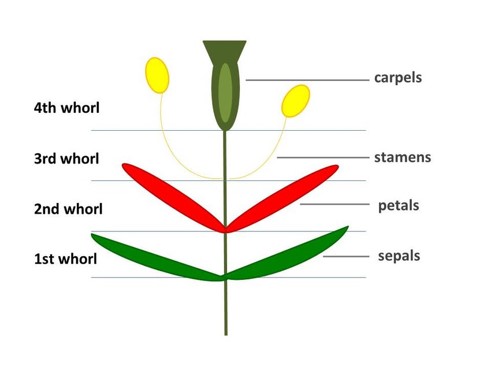
Most people have probably heard of “petals”, but there are many other parts of flowers that are just as important. The main ones being:
- Sepals: individual component of the outermost whorl of the flower, leaf-like or petal-like
- Petals: individual component of the second whorl of the flower, functions to attract pollinators and facilitate pollination
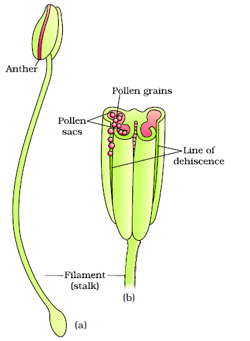
- Stamen: male reproductive structure consisting of a filament and a pollen-bearing anther
- Filament: stalk bearing the anther in a stamen
- Anther: pollen-bearing part of stamen
- Pollen: male gametophyte of seed plants, carries sperm cells to ovules for fertilization
Here is an image displaying the different parts of the stamen.
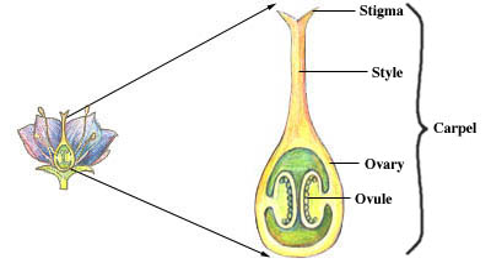
- Carpels: primary unit of a pistil, consists of an ovary, style, and stigma and contains ovules
- Stigma: top section of the pistil that is receptive to pollen
- Style: area of the pistil between the stigma and the ovary
- Ovary: ovule-bearing section of a pistil, forms the fruit wall
- Ovule: contains an egg cell and becomes the seed, located inside the ovary
Here is an image that displays the different parts of the carpel.
And finally here is an image displaying the main parts of a flower.
Inflorescence
Inflorescence refers to the shoot system that produces flowers. These can be either determinate or indeterminate, and there are many different types of inflorescences.
- Determinate: when the main axis of the inflorescence ends in a flower
- Indeterminate: when the growing point produces only lateral flowers or partial inflorescences
- Types of inflorescences:
- Raceme: indeterminate, single axis bearing pedicellate flowers
- Spike: indeterminate, single axis bearing sessile flowers
- Spathe: a leafy bract that subtends and partially surrounds the spadix
- Spadix: a thick fleshy spike
- Panicle: a compound raceme
- Corymb: a raceme with the pedicels elongated so all the flowers are approximately the same level
- Head/ Capitulum: inflorescence of sessile flowers borne on a flattened and expanded portion of the inflorescence axis
- Umbel: pedicels arise from the same point on the peduncle
- Cyme: composed of numerous three-flowered units usually with opposite branching
The most interesting piece of information about inflorescences is that a sunflower, or any related species in the same group, is actually a capitulum. This means that the petals on the outside are each individual flowers, and the “sunflower seeds” in the middle are actually their own flowers as well, which form into fruits. Meaning that “sunflower seeds” are actually fruit containing seeds.
Fruits
This is the most exciting part, in my opinion, because the way we talk about fruits can actually be misleading when it comes to what a fruit truly is. We commonly refer to fruits such as strawberries, raspberries, and blackberries as berries, which would make sense considering they all have “berry” in their name. However, none of those are actually berries. Most people also probably don’t know that a nut is a fruit as well. This can be easily understood if you know the definition of a fruit.
- Fruit: ripened ovary which houses the seeds
- Seed: fertilized ovule
- Simple fruit: formed from a single carpel or several fused carpels
- Aggregate fruit: formed from more than one separate pistil in a single gynoecium
- Multiple fruit: forms from multiple flowers that fuse into a single fruit
- Accessory structure: expanded fleshy receptacle
- Dehiscent: opening at maturity to release seeds
- Indehiscent: not opening at maturity
- Types of fruits:
- Pome: false fruit consisting of an expanded, fleshy hypanthium fused with the pericarp
- Drupe: fleshy, indehiscent fruit consisting of an exocarp, mesocarp, and a bony or stony endocarp
- Berry: fleshy, indehiscent fruit with one to many seeds embedded in a pulpy mesocarp
- Samara: dry, indehiscent fruit with wings formed from an expansion of the pericarp
- Nut: dry, indehiscent, unilocular fruit usually with one seed and a hard pericarp
- Achene: small, dry, indehiscent fruit derived from a unicarpellate pistil
- Caryopsis: dry, indehiscent fruit in which the single seed is fused to the pericarp
- Follicle: dry, dehiscent unilocular fruit opening along one line of suture
- Legume: dry, dehiscent uniocular fruit opening along two lines of suture
- Loment: elongate fruit that is constricted and fused between the seeds and dehisces into corresponding one-seeded sections
Now that you have seen and understand some of the types of fruits, I want to share some fruits that are commonly misunderstood in terms of what they actually are.
- Cucumbers are berries; therefore, pickles are also technically berries.
- Pineapple is a multiple fruit.
- Peaches and cherries are drupes.
- Avocado, banana, watermelon, and pumpkin are also berries.
- Apples and pears are pomes.
- Not only are tomatoes a fruit, but they are also berries.
- Strawberries are accessory tissue covered in an aggregate of achenes.
- Raspberries and blackberries are aggregate fruits made up of many smaller fruits called drupelets.
- Coffee “beans” are actually the seeds of a fruit.
I hope this exploration of flowers and fruits deepened your appreciation for the natural world around you. I’d love to hear your thoughts! Did the classification of any of these fruits or flowers surprise you? Do you have any interesting plant facts to share? Let me know in the comments! Like this post and subscribe if you enjoyed reading!
References
Pell, S. K., & Angell, B. (2016). A botanist’s vocabulary: 1300 terms explained and illustrated. Timber Press.
New South Wales Department of Primary Industries. (n.d.). Pomes. Retrieved September 2, 2024, from https://www.dpi.nsw.gov.au/agriculture/horti
culture/pomes#:~:text=Apples%2C%20pear
s%2C%20nashi%20and%20quince,grown%
North American Raspberry & Blackberry Association. (n.d.). What’s in a name?. Retrieved September 2, 2024, from https://www.raspberryblackberry.com/consu
name/#:~:text=Raspberries%20%26%20Bla
ckberries&text=Blackberries%20and%20ras
 Emily's Biology Blog
Leave a comment